Burr Grinder vs Blade Grinder: Which Is Better for Coffee?
March 17, 2026
Di Pacci — Grinder Guide · Australia 2026
Burr Grinder vs Blade Grinder — Which Is Better for Coffee?
✍️ By Mik Di Pacci · Founder & CEO, Di Pacci Coffee Company · Updated July 2026
The grinder is where great coffee begins — and it's the most overlooked piece of equipment in most Australian kitchens. No matter how expensive your espresso machine or how freshly roasted your beans, if your grinder produces an inconsistent grind, your coffee suffers. This guide breaks down the real difference between burr and blade grinders, which is right for espresso, and why every professional barista in Australia — without exception — uses a burr grinder.
⚡ Quick AnswerBurr grinders are categorically better for all coffee brewing — especially espresso. They produce consistent, uniform particle sizes that extract evenly. Blade grinders chop randomly, creating uneven particles that cause bitter, sour, inconsistent extraction. For espresso, a blade grinder is genuinely unusable. Entry-level burr grinders at Di Pacci start from around $250–$300.
95%Burr grinder — grind uniformity
18%Blade grinder — grind uniformity
100%Cafés using burr grinders
10–20 yrQuality burr grinder lifespan
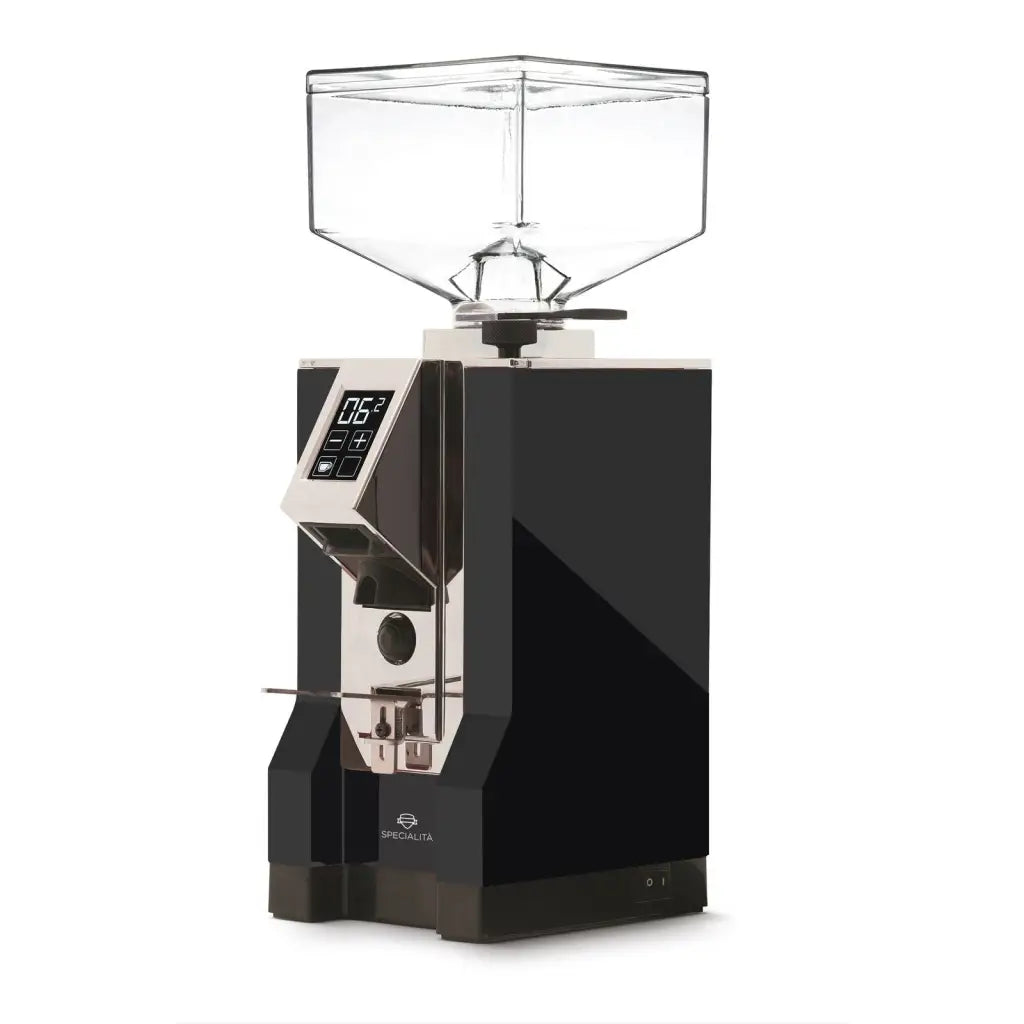
Burr grinder (left) — Eureka Mignon Specialita, Australia's most popular home espresso grinder. The difference in grind particle consistency between burr and blade is the single biggest determinant of coffee quality.1 — What Is a Burr Grinder?
A burr coffee grinder works by passing beans through two hardened abrasive surfaces — called burrs — set at a precise, adjustable distance from one another. As beans pass through the gap, they are crushed and sheared into particles of a highly consistent size. The gap determines the grind: close for fine espresso, wider for coarser filter or plunger grinds.
Conical Burr Grinders
Cone-shaped inner burr rotates inside a ring
Lower operating speed — less heat, less noise
Very low retention of old grounds
Sweeter, rounder espresso flavour profile
Great for home use and single-dosing
Flat Burr Grinders
Two parallel horizontal discs facing each other
Produces extremely uniform particle size
Greater clarity and brightness in the cup
Industry standard in Australian cafés
Ideal for dialling in specialty espresso
✅ VerdictBoth conical and flat burr grinders produce dramatically better results than blade grinders for every brew method. Key burr grinder brands at Di Pacci: Eureka, Mazzer, Compak, Fiorenzato, and Baratza.
2 — What Is a Blade Grinder?
A blade grinder uses a small, high-speed spinning metal blade — similar to a tiny propeller — to chop coffee beans into smaller pieces. There is no adjustable gap or grinding surface; the machine spins the blade at high RPM and relies on the operator pressing a button for a longer or shorter time to influence coarseness. Blade grinders retail for $25–$80 in Australia and are often marketed as multi-purpose kitchen tools for spices, herbs, and nuts.
⚠️ The Core Problem
Because there's no adjustable gap or burr surface, a blade grinder gives you no meaningful control over grind size. The result is always a random mix of particle sizes — from fine dust to large chunks simultaneously. The spinning blade also generates significant heat (20,000–30,000 RPM), which degrades coffee aromatics before the first drop is brewed.
3 — Key Differences — Burr vs Blade
Grinding Mechanism
Precision burr surfaces at controlled gap — beans sheared to target size consistently
High-speed spinning blade — random chopping, no controlled size
Particle Size
Narrow, bell-curve distribution centred on target — uniform extraction
Chaotic scatter — fine dust to large chunks in same grind simultaneously
Precise micrometric or stepless dial — repeatable every time
None — only duration, which is inconsistent even between identical uses
Durability
Hardened steel and alloy — 10–20 years with maintenance
Lightweight plastics — 2–5 years of light use
Price (AUD)
$250–$2,500+ home / $1,500–$8,000+ commercial
$25–$80
4 — Which Grinder Is Better for Espresso?
For espresso, the answer is unambiguous: only a burr grinder will do. Espresso is extracted by forcing water at 9 bar of pressure through a tightly packed bed of finely ground coffee in approximately 25–30 seconds. The resistance the puck provides — which determines shot time, extraction yield, and flavour — is directly controlled by grind consistency. Even a 10% variation in particle size causes water to channel through the puck unevenly.
🚫 Blade Grinders and Espresso
A blade grinder's chaotic particle distribution makes it essentially impossible to produce a repeatable, quality espresso shot. Fine dust causes channelling and bitterness; large chunks under-extract and thin the shot. No amount of technique or machine quality compensates. Even "pulsing" a blade grinder for 20 minutes won't match what a basic burr grinder achieves in 10 seconds.
Di Pacci's recommended burr grinders for espresso:
Best Overall Home Espresso GrinderEureka Mignon Specialita 55
55mm flat burrs, Silent Technology, stepless micrometric adjustment, programmable touchscreen dosing. The most popular home espresso grinder in Australia — near-café consistency in a whisper-quiet, compact package. The definitive upgrade from a blade grinder.
Best Professional-Grade Home GrinderMazzer Mini Electronic Type A
Café-proven workhorse with 58mm commercial flat burrs, stepless adjustment, and electronic shot counter. Commercial reliability at home — available at Di Pacci with Australia-wide service and support.
Best Entry-Level Espresso Burr GrinderBaratza Sette 270
40mm conical burrs, 270 macro and 9 micro settings, straight-through grinding path for ultra-low retention. One of the best-value espresso-capable burr grinders in Australia — a brilliant first step up from a blade grinder.
Starting with a blade grinder teaches bad habits and produces coffee that doesn't represent what your beans are capable of. The good news: excellent entry-level burr grinders are genuinely affordable. You don't need to spend $1,000+ to get dramatically better coffee than any blade grinder.
💡 Beginner PriorityIf budget is your primary constraint, spending $350–$450 on a basic burr grinder is a far better investment than spending $1,000 on an espresso machine paired with a blade grinder. The grinder has a bigger impact on cup quality than almost anything else. Finance options are available at Di Pacci — making it easy to start with quality equipment.
Baratza Encore ESP (~$400–$500) — the world's most recommended beginner burr grinder. 40mm conical burrs, 40 grind settings, dead-simple operation. View at Di Pacci →
Eureka Mignon Silenzio (~$600–$700) — the quietest grinder in its class. Stepless micrometric adjustment, 50mm flat burrs. Perfect for apartment living. View at Di Pacci →
Rancilio Rocky (~$700–$850) — a legendary, battle-tested conical burr grinder that's introduced Australians to quality home espresso for decades. Simple, durable, consistent. View at Di Pacci →
6 — Grind Consistency & Performance Comparison
Grind consistency — the uniformity of particle sizes produced — is the single most important metric when evaluating any coffee grinder. It directly determines how evenly coffee extracts, which controls flavour balance in your cup.
⚙️ Burr Grinder
Grind Uniformity95%
Espresso Suitability100%
Repeatability98%
Flavour Preservation92%
Value for Money90%
🔪 Blade Grinder
Grind Uniformity18%
Espresso Suitability5%
Repeatability22%
Flavour Preservation45%
Value for Money30%
7 — Price & True Value
The most common argument for blade grinders is cost. At $25–$80, they're easy to justify as "starter" equipment. But when you factor in the coffee quality you're missing from every cup — especially if you're buying $35–$60/kg specialty beans — the economics shift quickly.
🔪 Blade Grinder — True Cost$25–$80 purchase
✗Wastes premium beans on undrinkable shots
✗Cannot be dialled in for espresso — ever
✗Must be replaced when you upgrade (not if — when)
✗Heat damage degrades every bag of beans
✗True value for espresso: near zero
⚙️ Burr Grinder — True Cost$250+ — lasts 10–20 years
Walk into any café in Australia — from a Melbourne laneway specialty bar to a Sydney beachside kiosk — and you'll find exactly the same thing behind the counter: a burr grinder. This is the direct result of what these machines produce in the cup. A professional barista pulls hundreds of shots per day; every one must be consistent. Only a precision burr grinder delivers this.
MazzerMajor · Super Jolly · Kony E
The most ubiquitous commercial flat burr grinders in Australian cafés — bulletproof reliability, decades of proven performance.
EurekaAtom · Helios · Zenith
Italian-engineered commercial grinders with large burrs and quiet motors — increasingly popular in specialty cafés across Melbourne and Sydney.
CompakR120 · E5 · E10
Spanish-built flat burr grinders trusted for precision and consistency in high-volume café environments. Available and serviced at Di Pacci.
MahlkönigE65S · EK43
The benchmark for specialty coffee globally. The EK43 is the reference grinder for both espresso and filter in world-class Australian cafés.
Yes — categorically, in every measurable way that matters for coffee quality. Burr grinders produce a consistent, uniform particle size that extracts evenly, resulting in a balanced, flavourful cup. Blade grinders chop randomly, producing a chaotic mix of fine dust and large chunks that leads to bitter, sour, uneven extraction. For espresso, pour-over, and any method where grind consistency matters — that is, all of them — a burr grinder is the correct choice.
Espresso is extracted at high pressure (around 9 bar) in 25–30 seconds. Consistent particle size is critical — if grounds are uneven, water finds the path of least resistance, bypassing under-extracted chunks and flooding over-extracted fines. This "channelling" makes a shot simultaneously too bitter and too sour. Only a burr grinder delivers the uniformity espresso demands. A blade grinder's inconsistency makes a repeatable espresso shot impossible.
Yes — blade grinders are genuinely unsuitable for espresso. The random chopping creates an uncontrollable range of particle sizes, and the heat from the spinning blade (20,000–30,000 RPM) warms the grounds and degrades the volatile aromatics that give espresso its complexity. Even "pulsing" a blade grinder for 20 minutes won't match what a basic burr grinder achieves in 10 seconds. If you're pulling espresso, a burr grinder is not optional.
Professional baristas universally use burr grinders. In Australian cafés the most common are flat burr grinders from Mazzer (Major, Super Jolly, Kony E), Eureka (Atom, Helios, Zenith), Compak (E10, R120), and Mahlkönig (E65S, EK43). All feature large-diameter hardened steel burrs, stepless micrometric adjustment, and are built for hundreds of grinding cycles per day. Di Pacci supplies and services many of these across Australia.
Technically yes — a blade grinder can produce a passable result for French press or cold brew, where longer brew times partially compensate for inconsistent grind size. However, even for these methods a burr grinder consistently produces a noticeably better result with more body, sweetness, and complexity. Entry-level burr grinders at Di Pacci start from around $250–$300 and will transform any brew method, not just espresso.
The common signs: your espresso shots are inconsistent (sometimes 15 seconds, sometimes 45); your coffee tastes sour or bitter even with fresh, quality beans; you can't reproduce a good result reliably; or you've just bought an espresso machine and want to give it a fair chance. Any of these means a burr grinder upgrade will have a bigger positive impact on your coffee quality than almost any other change. Browse Di Pacci's home grinder collection to find the right match.
About the AuthorMik Di Pacci — Founder & CEO, Di Pacci Coffee Company
Mik Di Pacci is the Founder & CEO of Di Pacci Coffee Company, Australia's largest coffee machine and grinder specialist since 2008. Di Pacci sells, services, and supports burr grinders from Eureka, Mazzer, Compak, Fiorenzato, Baratza, and more across five Australian showrooms. Our in-house service team has repaired thousands of grinders — and never once seen a blade grinder in a professional kitchen.
Make the Switch to a Burr Grinder — Shop Di PacciEureka · Mazzer · Compak · Baratza · Fiorenzato · Finance available · Free shipping over $200 · (02) 9758 0760